192kHz Won’t Save Your Mix: Sample Rates, Explained Calmly
192khz wont save mix problems that better takes would fix. Sample-rate debates bring out a special kind of confidence in people. So let’s stay calm and stick to what’s established: the sampling theorem says you need a rate just over twice the highest frequency you want to capture. Human hearing tops out around 20 kHz on a great day. That’s why 44.1 and 48 kHz exist — they cover the audible band with room to spare. Most sample rate myths start right here, at the gap between what the math says and what a spec sheet implies.

192khz Wont Save Mix Problems: What Higher Rates Actually Buy
More relaxed filter design at the converter, lower latency at a given buffer, and headroom for extreme pitch/stretch work in sound design, where slowing a file reveals content above the audible band. Real benefits. Niche benefits.

What they don’t buy
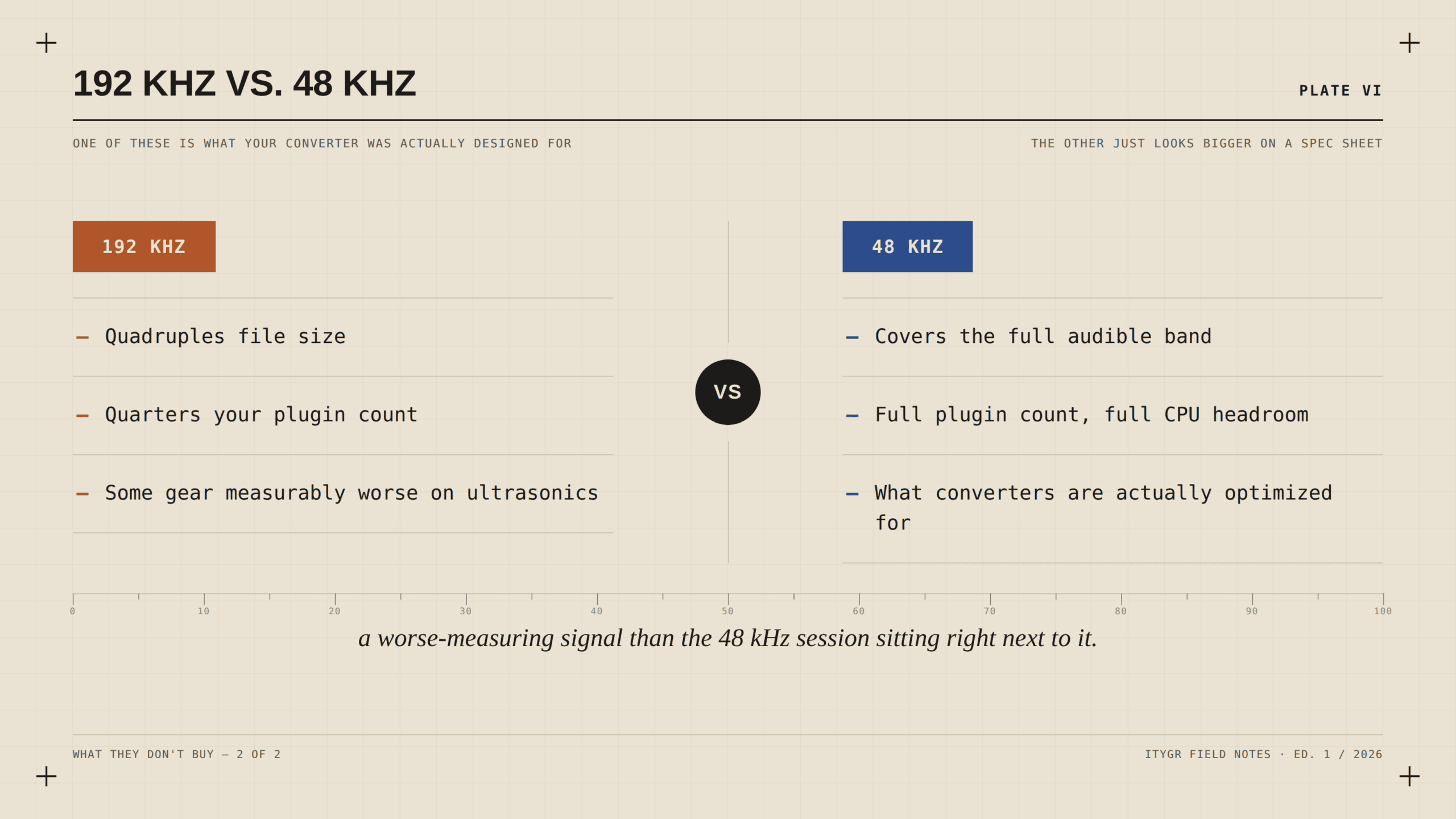
“More detail” in the band you can hear. The audible range is fully described at standard rates — that’s the theorem, not an opinion. Meanwhile 192 kHz quadruples file sizes, quarters your plugin count, and some gear performs measurably worse handling ultrasonics it was never asked to reproduce. That is the whole argument: 192khz wont save mix decisions that were already wrong.
There’s also a practical wrinkle worth knowing: converter manufacturers optimize their filters and clocking for 44.1, 48, and 96 kHz — the rates almost everyone actually uses. Push a session to 192 kHz on gear that wasn’t designed around it, and you can expose ultrasonic noise and intermodulation artifacts that fold back down into the audible range as extra noise or harshness, not extra fidelity. That’s shown up in independent converter measurements more than once. So the risk in chasing a bigger number isn’t just wasted disk space — sometimes it’s a worse-measuring signal than the 48 kHz session sitting right next to it. 192khz wont save mix quality on its own — the converter design still matters more.

The honest position
Track at 48 kHz, spend the saved CPU on better takes, and let sound designers use the high rates they genuinely need. If you want the same argument made about a different piece of studio mythology, the $2,000 cable post covers the same territory. Nobody ever streamed your song and said “shame about the sample rate.” 192khz wont save mix time either, since the CPU cost is real and the benefit is not.

If a number on a spec sheet were audible, we’d all hear the difference between our interfaces. We hear the difference between our rooms.