Don’t Be That Guy: The Annoying Engineer
You know the guy: he shows up an hour before doors, plugs in his own laptop, and within four minutes has told the volunteer drummer that his overheads are “phasey.” He hasn’t listened to a single song yet. He heard the room for maybe thirty seconds. But he’s already got notes.
I’ve been that guy. That’s how I know the type so well.
The annoying engineer isn’t bad at audio: that’s the frustrating part. He usually knows things. He can explain the 3:1 rule. He can spot a 60Hz hum from across the room. He’s read the manual on the console he’s never actually mixed on. The knowledge is real. It’s the delivery that’s broken, and the delivery is most of the job.


Because here’s what nobody tells you when you’re twenty-two and finally understand gain structure: being right is roughly fifteen percent of the work. The other eighty-five is making a room full of humans want to do the thing you’re right about.
The tells
He corrects instead of asking: “Your kick is clipping” lands very differently than “hey, is your kick hitting the input pretty hot?” One of those makes a volunteer defensive. The other makes them curious. Same information, thirty percent fewer words, one hundred percent less friction.
He talks in jargon on purpose: if you say “the LF is smeared because your delay alignment is off” to a worship leader, you didn’t communicate. You performed. Say “the low end sounds mushy in the back — let me check the timing on the fills.” Same sentence. Now everybody’s on the same team.
He changes things without telling anybody: this is the big one. He re-patches the stage during rehearsal because his way is better. He deletes somebody’s scene. He moves the wedges eighteen inches and doesn’t mention it. Then the regular tech shows up Sunday and nothing is where they left it, and they spend the first song confused instead of mixing. Your improvement cost somebody else their footing.
He has a gear opinion for every occasion: unsolicited. Always. “You know an X32 isn’t really a professional console.” It’s mixed more services than most of us have attended. The console isn’t the problem. Nobody asked. Read the room.
And he never, ever says “I don’t know”: which is how you can spot the actual pros in a hallway. The best engineer I’ve worked under said “I’m not sure, let me try something” out loud, in front of a band, without flinching. It made everybody trust him more, not less.
Why it matters more in a volunteer room
In a touring context the annoying engineer gets absorbed. Everybody’s paid, everybody’s tough, the show goes up. Church production doesn’t work like that. The person you just embarrassed is here on their day off. They drove twenty minutes. Nobody’s making them come back next week.

I’ve watched a good volunteer quit over one comment. Not a cruel comment — just a correction, delivered flat, in front of the band. She never said anything about it. She just stopped signing up. That’s a person and a skill set gone because somebody needed to be right out loud.
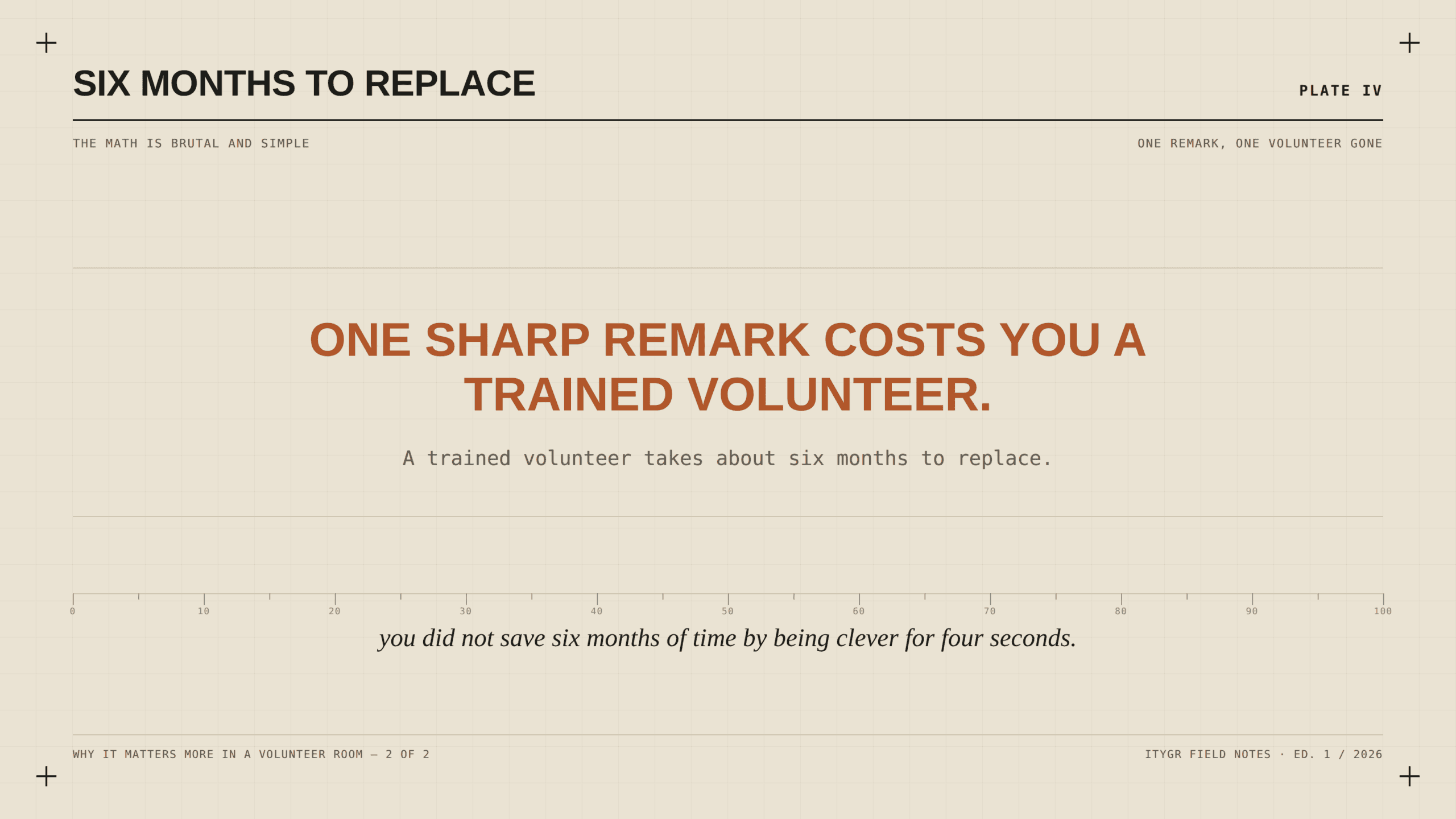
The math is brutal and simple: one sharp remark costs you a trained volunteer, and a trained volunteer takes about six months to replace. You did not save six months of time by being clever for four seconds.
I’ve learned this lesson from the other side, too — the day I let my own ego mix the aftermath of a blown monitor cue right along with the actual monitors. Same lesson, different gear: I wrote about that one here.
Nobody remembers the mix. Everybody remembers how you talked to them while you were fixing it.
How not to be him
Listen to one full song before you say anything: not thirty seconds. A whole song, front to back, from where the people actually sit. Most of what you were about to say gets answered by the second chorus, and half of it turns out not to be a problem at all.
Ask before you touch: “mind if I move this?” costs you ninety seconds across an entire rehearsal. It buys you a room that isn’t braced for your next move.
Teach the thing you were going to complain about: if the kick is hot every single week, don’t sigh about it every single week. Spend ten minutes showing somebody the gain knob and the meters and why we’re aiming for that range. Now it’s fixed forever instead of fixed by you, weekly, with visible fatigue.
Praise in public, correct in private, and mean both: old advice, still undefeated. If the drummer’s overheads genuinely are phasey, catch him after and show him the waveform on a laptop. Two minutes, nobody’s face gets hot, and he learns something he keeps.
Let small things go: this is the discipline nobody teaches. Not every imperfection is your assignment. A slightly bright hi-hat at 11am on a Sunday is not a hill. Consistency wins more Sundays than correctness does, and a room full of people who like working with you is worth more than any single fix you’ll ever make.
The reframe that fixed it for me: I stopped asking “is this right?” and started asking “is this useful, to this person, right now?” Most of my best notes failed that second test. So I kept them to myself, and the mixes got better anyway — because the band was relaxed and the volunteer beside me wasn’t waiting to get corrected.
Skill you can’t deliver kindly isn’t skill yet. It’s just information with your name on it.


Gear in this post
Behringer X32 (~$2,600 new, often $1,200–1,600 used) — the console that has quietly mixed more Sunday services than any boutique desk on the internet. It is not the reason your mix is bad.