sE V7 vs the SM57: What the Charts Actually Say
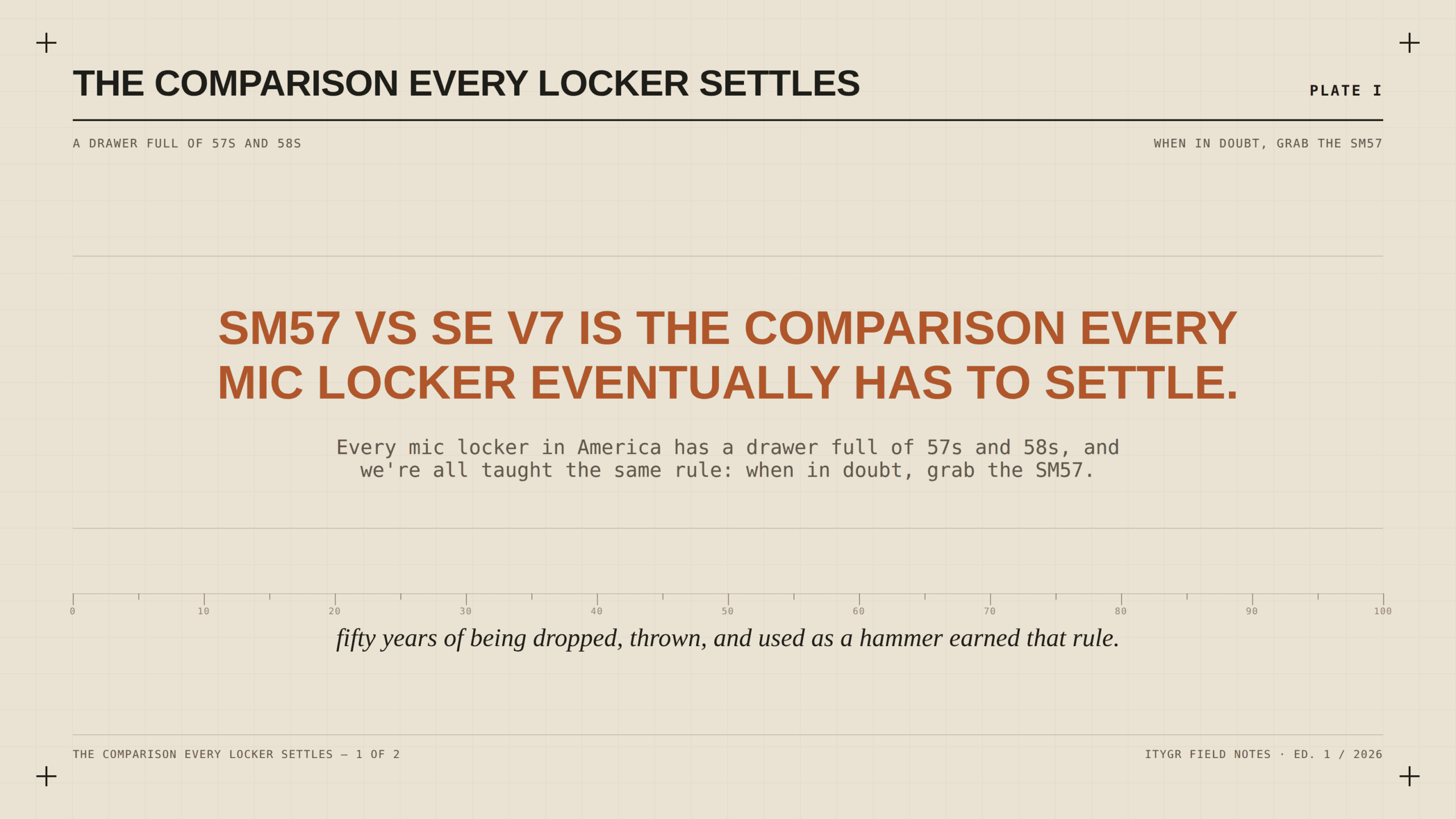
SM57 vs sE V7 is the comparison every mic locker eventually has to settle. Every mic locker in America has a drawer full of 57s and 58s, and we were all taught the same rule: when in doubt, grab the Shure. Fifty years of being dropped, thrown, and used as a hammer earned that rule. So instead of telling you a story about which mic “won,” let’s do something more useful. Look at the curves. Bookmark the SM57 vs sE V7 comparison chart above before you buy either mic.

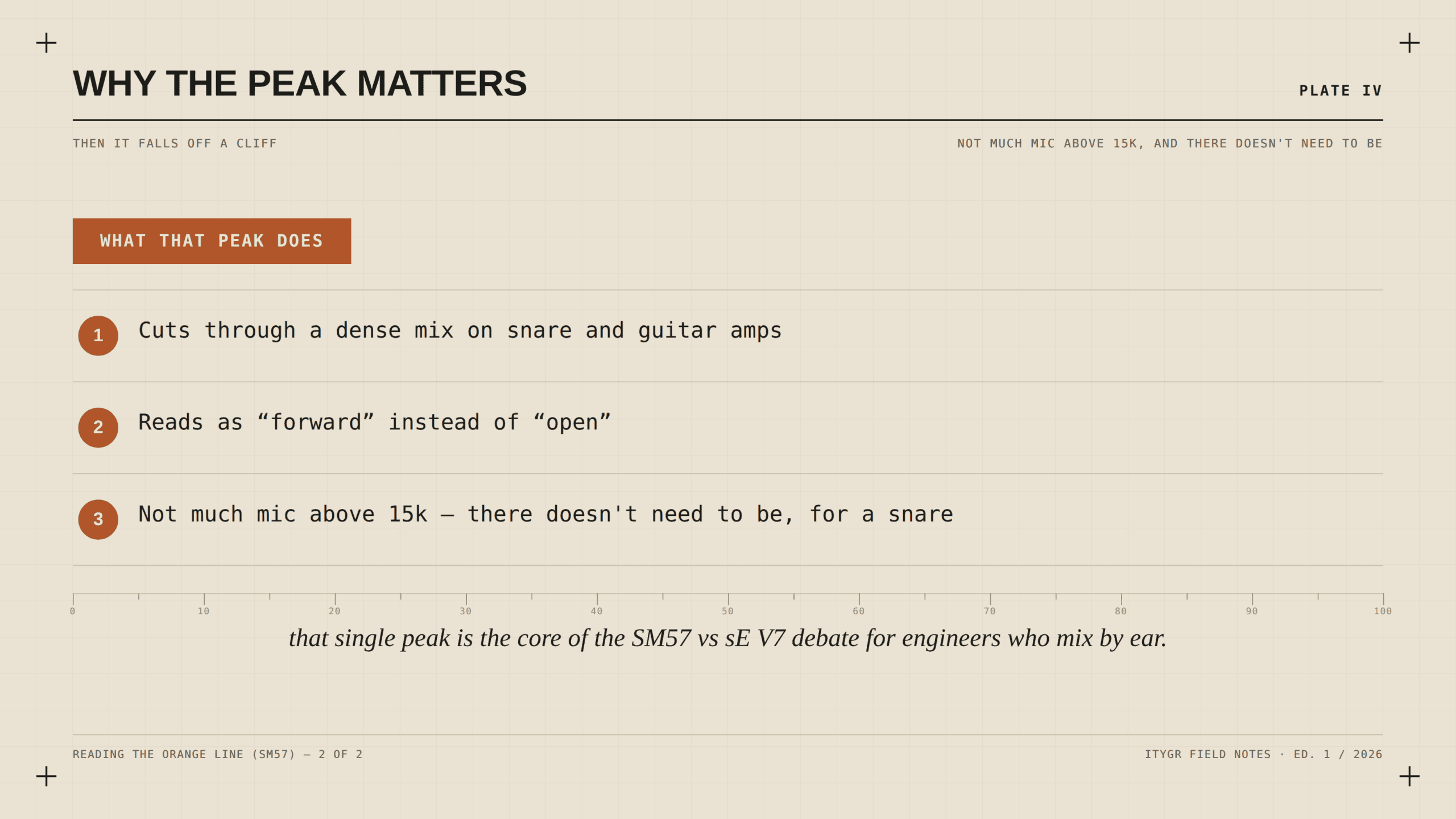
Reading the orange line (SM57)
40 Hz to 15 kHz, with that famous presence peak — roughly +7 dB centered near 6 kHz — then it falls off a cliff. That peak is the whole personality. It’s why a 57 cuts through a dense mix on snare and guitar amps, and it’s also why a 57 vocal can read as “forward” instead of “open.” There’s not much mic above 15k. There doesn’t need to be for a snare. That single peak is the core of the SM57 vs sE V7 debate for engineers who mix by ear.

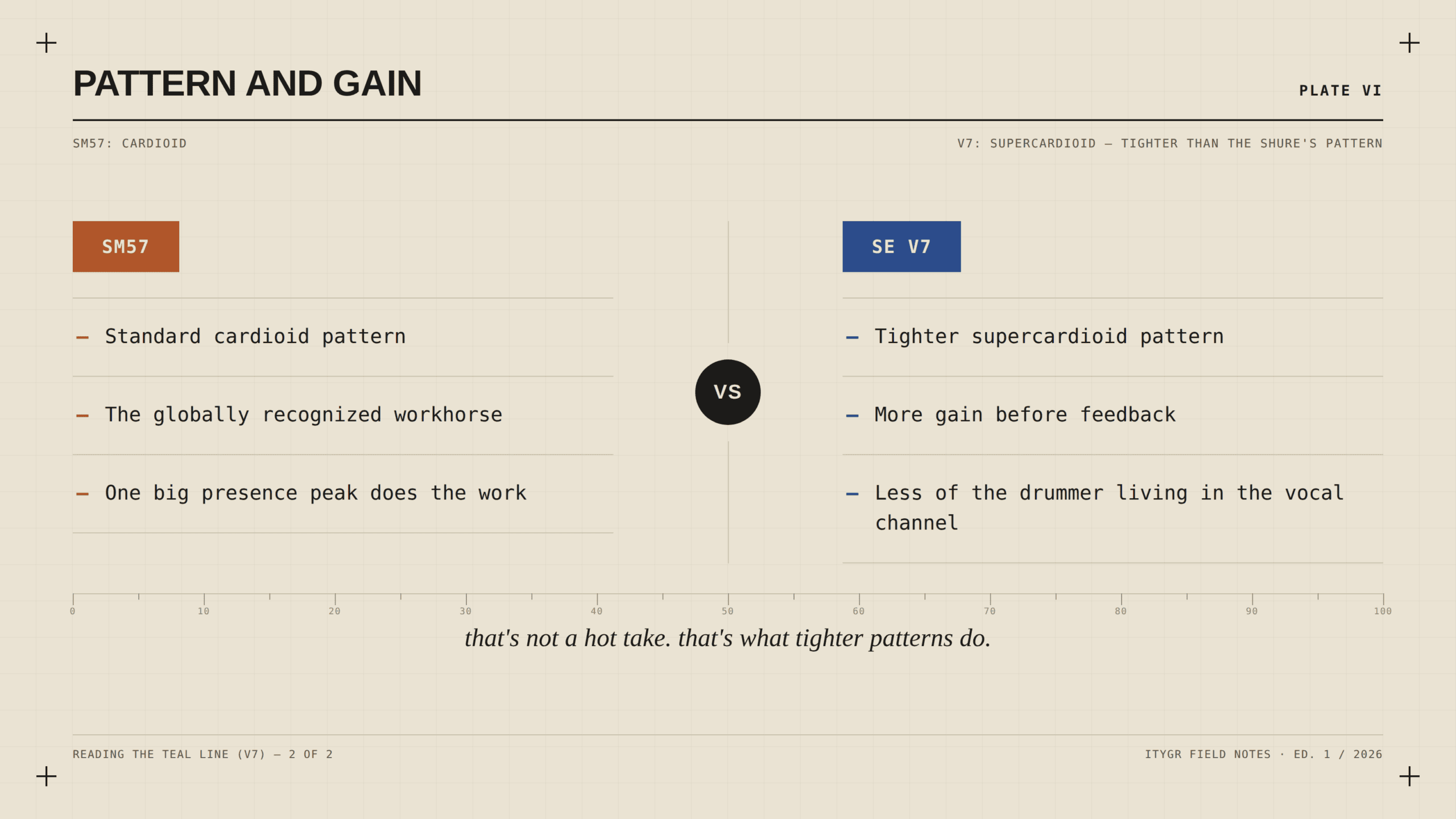
Reading the teal line (V7): 40 Hz to 19 kHz, and instead of one big peak, two gentle lifts — one around 3.5 kHz for intelligibility, one around 10 kHz for air. That second lift is the part you hear as “expensive.” Add the supercardioid pattern — tighter than the Shure’s cardioid — and on paper you get more gain before feedback and less of the drummer living in the vocal channel. That’s not a hot take. That’s what tighter patterns do.

Once you see both curves side by side, the SM57 vs sE V7 question mostly answers itself.
Verdict: SM57 vs sE V7
For a lead vocal on a loud stage, the V7’s chart is simply shaped more like the job — air on top, controlled pattern, no 6k spike to tame. That’s the mic I reach for, personally — no hedging there. But let’s be straight about the SM57 too: it’s still the king. Not because a chart says so — because fifty years of shows said so. Every stage on earth has one, every engineer trusts it without thinking twice, and on snare and amps nothing has knocked it off its perch. My preference for the V7 doesn’t put a dent in that. Both things are true at the same time: I like the V7 better on a lead vocal, and the SM57 is still the most globally recognized, unkillable workhorse mic in the business — the one you grab when it just has to work, everywhere, no questions asked. Pick the V7 if you want what I actually use. Pick the 57 if you want the mic every engineer on the planet already knows how to run blind. If you’re building out a vocal mic locker and want the condenser side of that same conversation, the Twin87 breakdown covers the other end of it. In practice, SM57 vs sE V7 comes down to how much top-end air the room can handle before it turns harsh.

Don’t take my word for it — that’s the point. The charts are public. Match the curve to the job and half the mic debate disappears.
That is the entire SM57 vs sE V7 argument in one sentence.

Gear in this post
Shure SM57 — Amazon
sE Electronics V7 supercardioid dynamic vocal mic — check the current price on Amazon
Heads up: affiliate links. If you buy through them, Itygr earns a small commission at no extra cost to you — it helps keep this training free.
Keep reading